
Stepping into the Flames#
When my close friend and advisor @earth2marsh.com suggested that I propose a short ATmosphereConf talk about how I license my new software project, I immediately thought “Yikes! Talk about closed source at an event about an open social protocol? People are going to hate that!” But one thing that I’ve learned working with Marsh is that whenever he and I see things differently, there’s usually a learning opportunity for me, so I embraced his idea and made the proposal.
If you’re curious, a written version of the talk is here. It was scheduled for 4:20 on the last day of four days of conference activities, so I had three and a half days of the conference to spend watching all of the talks about open source projects and thinking about stepping into the flames by talking about my project that is not (yet?) open sourced.
What Happened in the Furnace#
I was startled to find that the session went pretty well. I was not booed or heckled, and although I was wearing my reading glasses and couldn’t see everyone clearly, at least a few people in the audience seemed visibly startled and amused by my talk’s punch line:
If @agent.io follows you, you’re in the beta!
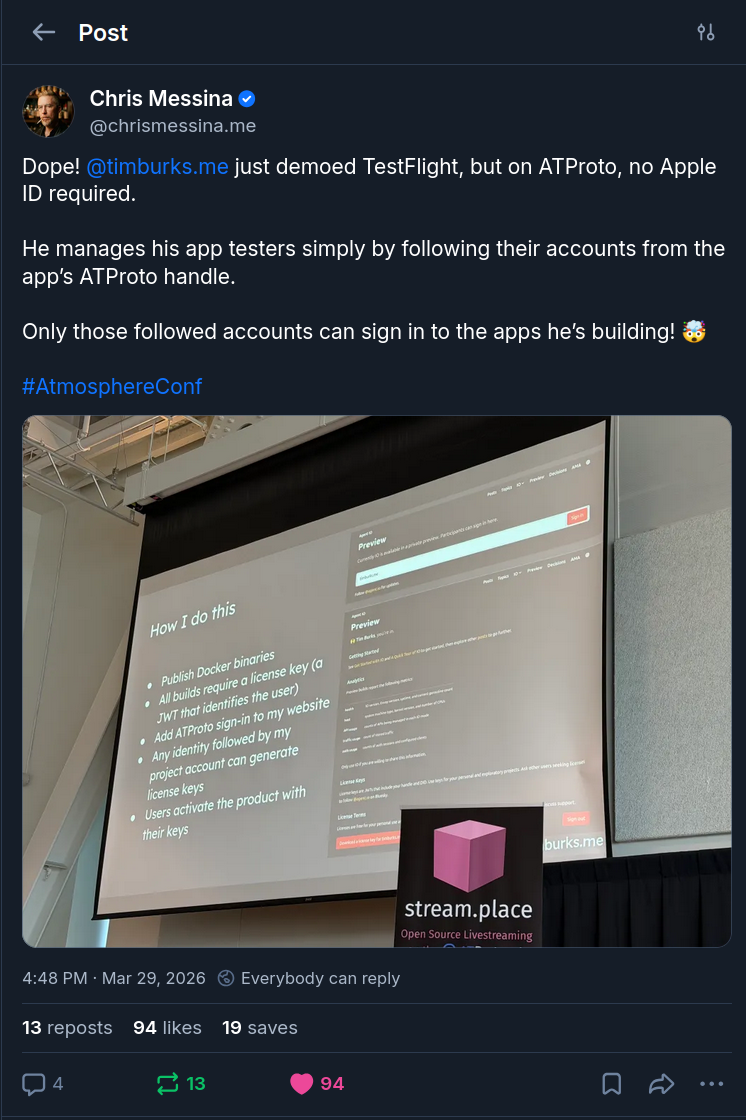
Chris Messina’s post captured it beautifully, and in the replies, a couple of posters said they were doing this too, although these replies seem to be deleted now, so maybe those posters weren’t actually doing this or maybe they changed their minds about associating with this bandwagon. I also noticed a few dissenting comments in the conference chat stream that didn’t @-mention me, so I won’t repeat or engage with them, and honestly, I get it. We all benefit from open source software and should pay back from what we’ve gotten. Open Source is Good.
So Who Pays For It?#
This is one of the big rubs of open source. As I mentioned in my talk, in a previous job, I built an open source component that, without my knowledge, was picked up by the Kubernetes team and used to improve kubectl and I got nothing in return for it. I was working at Google at the time, so yeah, I was getting paid, but I wasn’t on the Kubernetes team and none of my managers or perf committees ever valued what I had done for them, so like lots of open source projects, it eventually became a tax on me for having made it.
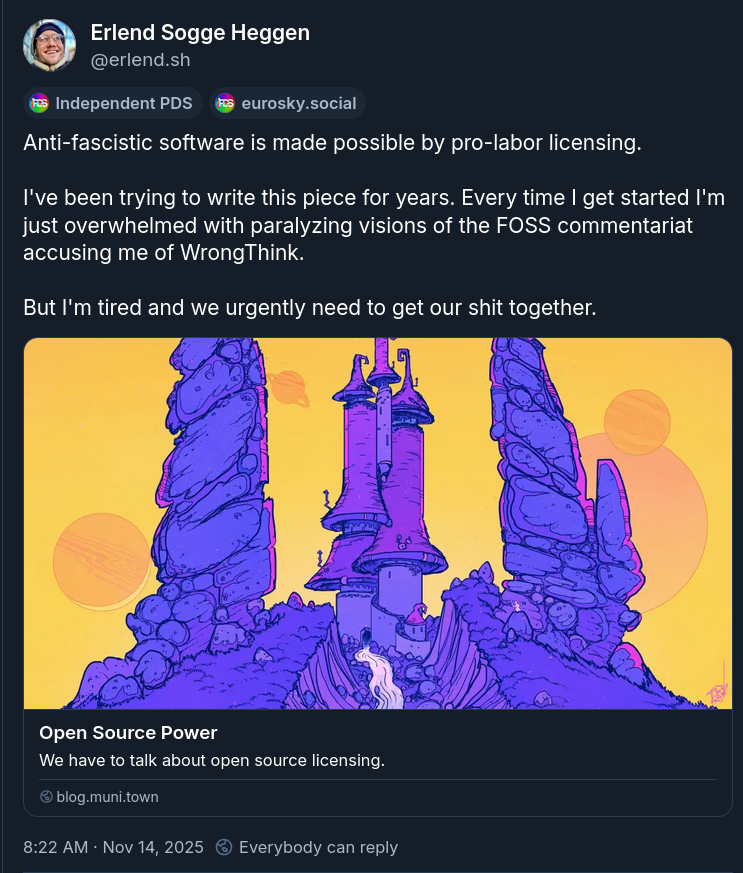
This is of course waaaay bigger than me. While reading reactions to my talk, I found Erlend Sogge Heggen’s article titled Open Source Power. He’s written the best articulation of the problem that I’ve seen, and it points out that the biggest beneficiaries of Open Source are the richest people in tech, who unsurprisingly aren’t paying enough for that work.
We Should Start with Workers’ Rights#
The open source movement is built on Four Essential Freedoms articulated by the FSF in 1986:
- The freedom to run the program as you wish, for any purpose (freedom 0).
- The freedom to study how the program works, and change it to make it do what you wish (freedom 1). Access to the source code is a precondition for this.
- The freedom to redistribute copies so you can help others (freedom 2).
- The freedom to distribute copies of your modified versions to others (freedom 3). By doing this you can give the whole community a chance to benefit from your changes. Access to the source code is a precondition for this.
This forty year-old definition triggered many spinoffs, a leading one being the Open Source Initiative, which catalogs and approves licenses that align with its values.
“We defend the rights of all software users” is at the root of the FSF’s values and free software has been good for users in many ways. But here’s something that we might have forgotten: in 1986, most of the users of software were also the workers who were making software. That’s far from true today.
Now everyone in the world is a software user, and virtually all of those users are using proprietary platforms owned by wealthy individuals and corporations who built empires on software that mixes closed and open-source code. Now truth-be-told, it’s mostly open source code that powers our world as components of closed-source products. Those closed-source products are built by millions of workers who hand over their intellectual property rights to their employers in exchange for wages.
The First Right of the Worker is to Decide Who Benefits From Their Work#
In Open Source Power, Erlend looks at the OSI’s definition of open source and observes:
This definition of open source prohibits discriminating against megacorps and nazis.
There are lots of things that we can list that are important workers’ rights and I don’t want to exclude them, but I claim here that many of them flow from a single vital right:
My right to decide who benefits from my work.
Think about that for a minute.
Software creation is an intellectual effort, so when we think of workers’ rights, we have to think about intellectual property rights. When workers create, what rights should they have over their creations? How should those rights persist outside of the boundaries of their employment?
Investor-owned software should be open source#
Here’s the first corollary of the idea above. It meets and exceeds the original requirements laid out by the FSF, and it directly addresses the toxic behavior of tech empire-builders. Any software owned by investors, which I describe as the funding sources who pay creators in exchange for ownership of their work, must be open source.
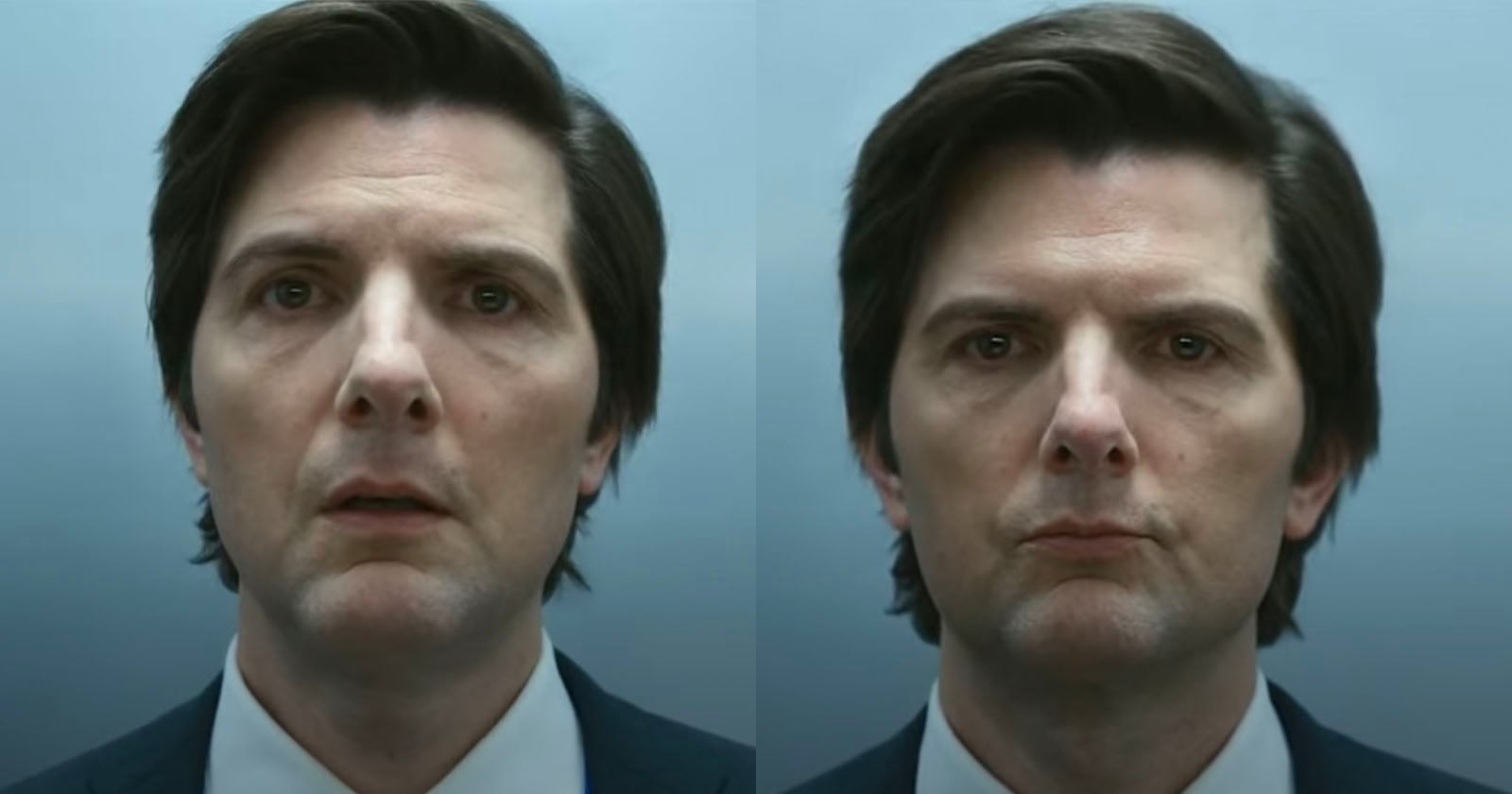
This gives workers the freedom to access their ideas outside of their employment, ending the Severance-style mindfucks of corporate software jobs. It also gives users the visibility and protection from abuse that Free Software was supposed to provide and didn’t when developers sold out to investors.
Creator-owned software should be whatever its creator wants it to be#
The second corollary is this: individual creators have the right to keep their work private and to control who benefits from it. If that means they are ignored, that’s fine, that’s their right, as much as it’s anyone’s right to decide whether or not to work for Big Evil Spyware.
As Katerina Marchán points out, creators do often decide to do their work in the open, trading exploitation for publicity.
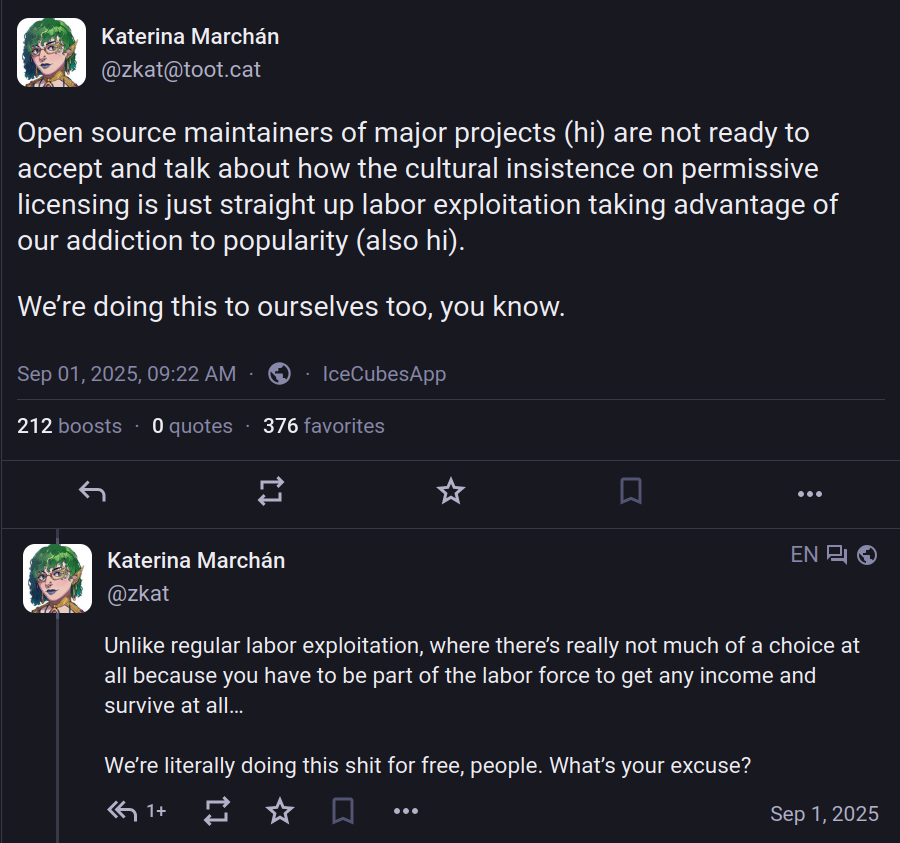
This is all subject to the First Corollary: when a creator moves to get support by selling partial ownership of their work, the software that they are selling should be open with everyone (investor, creator, and audience) understanding what that means.
Collective Problems and Individual Actions#
As we’ve seen, it is observably and objectively bad for society when investors own closed source software. That starts by being bad for tech workers, creators lose the right to the value that they create, and users are still harmed because they don’t get the protection from spying and abuse that open source promised them.
Before you take shots at solo developers with closed source projects, ask yourself this: what corporate closed-source software are you using? What power structures are you building by doing that? Does punching down (or sideways) make you feel like a hero while corporate closed source providers make you their patsy?
The Ladder That Leans On The Wrong Wall#
The open source movement is a ladder that leans on the wall of users’ rights. We’ve spent forty years climbing that ladder. Where are we now? Our world is controlled by moguls who’ve built empires using open source software that they’ve locked behind proprietary barriers. Those empires exploit workers and the users that the open source movement was supposed to protect.
Our ladder is leaning on the wrong wall.